Poland has firmly established itself as a furniture producer in the European market, with only China exporting more furniture to Europe. This shift in the production landscape presents logistics providers with a key question: How can Eastern European manufacturing be connected with the expectations of end customers in Western Europe? Hermes Furniture Delivery Service (HES) and the Anton Röhr Logistic Group have found an answer by consistently dividing responsibilities according to their respective core competencies.
When Production Geography Changes Logistics Strategies
The European furniture industry has undergone a major transformation. While design and sales often remain based in Western European markets, production is increasingly shifting eastwards. Poland is now the continent’s second-largest furniture supplier, a position that offers retailers cost advantages but also creates logistical complexity.
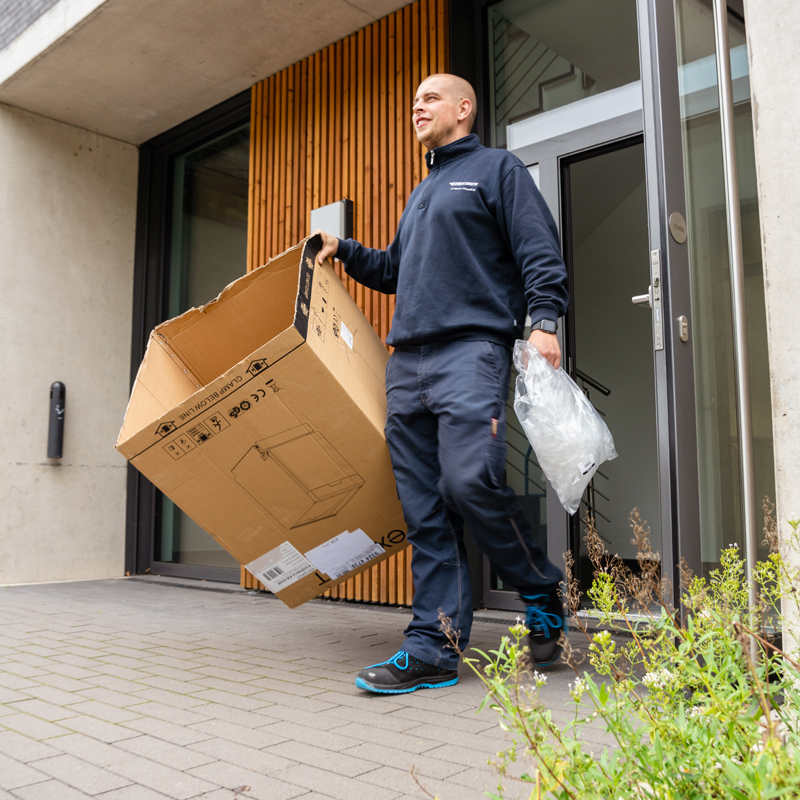
The key challenge is that furniture is not a standard product. It is bulky, delicate and high-value. For a positive customer journey, end customers expect delivery and additional services such as preferred delivery dates, assembly, disposal of packaging materials and old furniture removal from a single source. Meeting these requirements across national borders requires more than conventional freight transportation. So how does a sofa set get from Poland to the customer’s living room?
“The Polish furniture industry has developed enormously,” explains Heiko Hufenbach, Business Development Manager at HES. “For us, it was clear that efficiently transporting these goods to Western Europe requires a partner that understands Eastern European logistics just as well as we understand end customer delivery. With Röhr, we have found exactly that partner.”
Mosina: From Individual Shipments to Consolidated Loads
In Mosina, south of Poznań and directly on the A2 motorway between Berlin and Warsaw, Anton Röhr Logistyka Sp. z o.o. operates a logistics centre with 89,000 m² of warehouse space on a 210,000 m² site. This is where a process that is often underestimated in logistics takes place: consolidation.
Polish furniture manufacturers are often highly specialised. One produces upholstered furniture, another cabinet furniture, and another kitchens. If each manufacturer transported its products individually to Germany, this would result in inefficient partial loads. Costs would increase, emissions would rise, and delivery times would become longer.
Röhr consolidates these fragmented flows of goods at a central location. Every day, between 50 and 80 articulated trucks arrive at or leave the site. Cross-docking processes minimise dwell times, with goods transferred directly from inbound to outbound transport. What arrives in Mosina as individual shipments leaves as an optimised consolidated load.
Mosina’s geographical location further enhances this advantage. From there, consolidated loads can reach their target markets in Germany directly via the A2 motorway.
Division of Responsibilities Based on Expertise, Not Geography
The cooperation between HES and Röhr is based on a clear division of responsibilities: each partner focuses on the expertise it has perfected over decades.
Who Benefits Specifically?
- Polish manufacturers gain access to Western and Central European markets without having to establish their own distribution structures. Consolidation in Mosina significantly reduces transport costs per unit.t- und mitteleuropäische Märkte, ohne eigene Distributionsstrukturen aufbauen zu müssen. Die Konsolidierung in Mosina senkt Transportkosten pro Einheit erheblich.
- Retailers and e-commerce platforms can integrate Polish products into their ranges without having to manage cross-border logistics themselves. Röhr handles the first and middle mile, while HES manages the last mile, ensuring a seamless end-to-end process.
- End customers benefit from premium services regardless of the production location, including preferred delivery dates, shipment tracking, assembly, disposal of packaging materials and old furniture removal.
Sustainability Through Consolidation and Electrification
Both partners pursue ambitious sustainability goals. HES is continuously electrifying its fleet and aims to use fully electric vehicles for deliveries in Germany’s largest cities and metropolitan areas by 2030. More than 200 charging points powered by certified green electricity are already in operation.
Röhr contributes to reducing emissions through intelligent consolidation. Fully loaded vehicles generate significantly less CO₂ per item of furniture than partial loads. Consolidation in Mosina therefore makes sense from both an environmental and an economic perspective. Consolidation, route optimisation and increasing electrification combine cost efficiency with sustainability.
Scalability Through Standardisation
The online furniture market continues to grow. This development requires logistics structures that can handle fluctuations in shipping volumes. The partnership between HES and Röhr is designed to meet these requirements: the HUB system in Mosina can be expanded, while the HES depot network is already established across Europe. New manufacturers can be integrated and additional markets can be served.
Standardised, digitalised and proven processes enable shipping volumes to increase without compromising quality, which is a key requirement for sustainable growth in a dynamic market.
Conclusion: HES and Röhr: Specialisation as a Strategic Advantage
The cooperation between HES and the Anton Röhr Logistic Group demonstrates a fundamental principle of modern B2B logistics: cross-border supply chains cannot be managed through scale alone, but require a focused division of responsibilities.
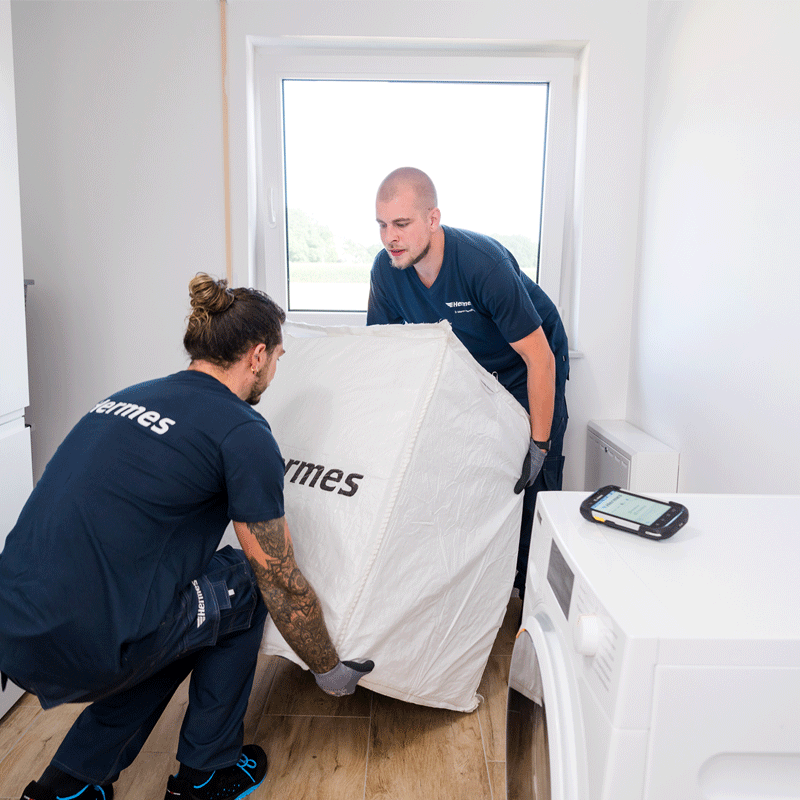
Röhr contributes its expertise in Eastern European logistics and consolidation. HES handles end customer distribution and service-oriented 2-man handling. For retailers, manufacturers and e-commerce providers, this partnership provides access to efficient East-West logistics structures without the need to build their own infrastructure.
From the Polish factory to the customer’s living room in Western Europe, the entire supply chain operates seamlessly, transparently and with a strong focus on service.