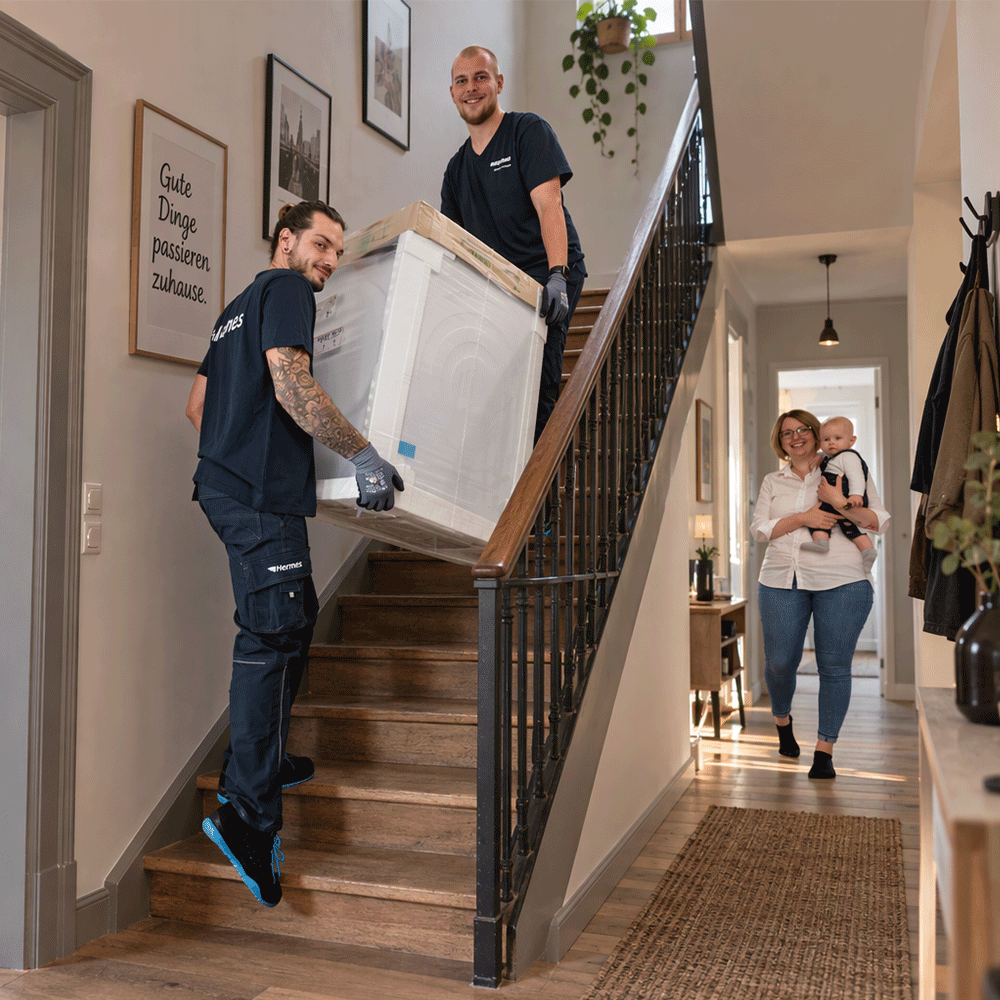
Completing a purchase is not the end of the customer journey. For large electrical appliances such as washing machines or refrigerators, it is often just the beginning. Carrying the appliance to its place of use, installation, customer guidance and the first use after delivery are often crucial in determining whether customers are satisfied, make a complaint or buy again.
For retailers and manufacturers, after-sales is therefore evolving from a mere cost factor into a strategic tool for customer loyalty and repeat purchases. The following six levers show what really matters.
1. Meeting expectations: After-sales starts before the first use
One study shows that 43 percent of respondents did not know that “kerbside delivery” means delivery only as far as the street and that customers have to carry their order into their home themselves.
This lack of information often leads to frustration and is a good example of how dissatisfaction frequently has less to do with the product itself than with the gap between customer expectations and the actual scope of service. This gap can be closed by treating delivery as part of an end-to-end service experience.
This relationship becomes particularly clear with white goods: for more complex products, there is a crucial step between “delivered” and “satisfied”, and this is exactly where after-sales comes into play.
2. The first use determines customer satisfaction
The moments following delivery are particularly important for customer satisfaction, as this is when customers put the product to the test in everyday use. Complaints are not always caused by a defective product. Problems often arise during the first use, for example:
- A refrigerator is switched on immediately after transport, even though it should first be left to stand.
- A washing machine does not work because the water supply has been left turned off.
- The TV itself is technically working perfectly, but the Wi-Fi connection has not been set up.
Product defect? User error? Lack of guidance? For customers, this distinction matters very little. Their experience is simply that the desired result has not been achieved.
This is where the real role of after-sales begins: preventing problems from arising in the first place and answering questions before they turn into complaints.
3. Communication after delivery as an underestimated lever
Radio silence after delivery? Better not.
If a question about how to use a product goes unanswered or resolving transport damage takes too long, initial uncertainty can quickly turn into genuine customer dissatisfaction.
Digital channels can provide proactive support here. HES uses its digital assistant to handle customer enquiries via chat and voice channels and document every interaction. This means that when customers have follow-up questions, they do not have to start from scratch each time.
Even better than answering a question, however, is preventing it from arising in the first place through a professional handover.
4. Installation is only complete when the product is ready to use
This is exactly where services that bridge the gap between delivery and actual use come in.
Position the appliance, connect it, done? That approach is too simplistic. For customers, the real value begins after installation. A TV, for example, only delivers its full benefit once the picture, sound and connected devices are working properly.
Depending on the agreed scope of services, this is an integral part of the HES service. Assembly, connection and a functional check directly at the place of use by trained teams help reduce the need for technical support afterwards.
5. The final minutes on site provide the most valuable insights
The final minutes of a delivery provide valuable information that can later determine customer satisfaction or help explain complaints.
Two-man handling teams experience first-hand how the handover takes place. They know whether the delivery arrived late, whether questions remained unanswered, whether the installation location had to be adjusted or whether there was any uncertainty regarding the use of the product.
These impressions are difficult to reconstruct afterwards, yet they are extremely valuable for retailers and manufacturers. They help put complaints into context and identify recurring issues before they develop into larger problems.
HES records this information, among other things, in its monthly reporting so that irregularities become visible at an early stage rather than only once they occur repeatedly.
These insights, in turn, help continuously develop service offerings and tailor them more precisely to different product groups.
6. Modular service levels make after-sales economically viable
A successful after-sales process starts with selecting the right service level.
Not every product requires the same level of support. While professional delivery to the customer’s preferred location is sufficient for some products, others benefit from installation, connection or the removal of an old appliance.
Modular delivery models enable retailers to select exactly the services that best suit the respective product group.
As specific requirements often become clear only after the purchase has been completed, HES also allows customers to add additional services themselves within defined time frames. Customers can also upgrade from Smart to Premium without making the overall process unnecessarily complex.
In addition, value-added services such as installation, customer guidance or old appliance removal represent a commercial opportunity in their own right that goes beyond the product price, but is often still not communicated sufficiently.
The untapped potential is also confirmed by the HES study “Delivery as a Success Factor”: for example, 40 percent of the furniture buyers surveyed stated that they had not been offered a packaging disposal service, even though 60 percent of them would have liked to use one.
Conclusion: After-sales means preventing problems before they arise
After-sales is still often understood primarily as a response to problems. In reality, however, the first few hours after delivery can determine how satisfied customers are and whether problems arise at all.
When retailers actively manage this stage of the customer journey, the focus shifts from complaint management to prevention. What was once considered an operational service process can then become a strategic competitive advantage.