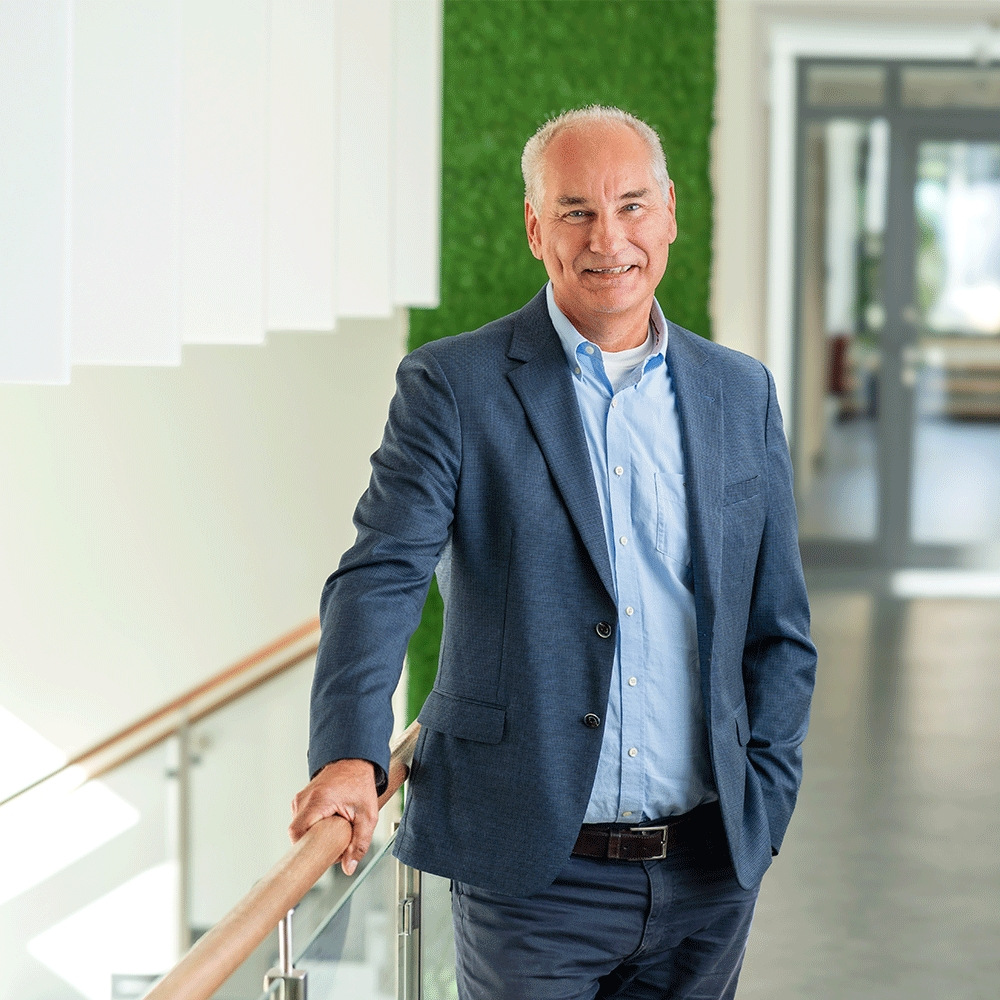
In our series “Leadership in Transition: How HES Is Taking New Approaches”, we explore how modern leadership culture is put into practice. This time, we focus on Jens-Uwe Sander, Division Manager Sales, Marketing & Client Service. He provides insights into his day-to-day leadership and shows what changes when trust becomes a guiding principle, in collaboration, decision-making and ultimately in the results.
Trust instead of control: What leadership looks like today
Jens-Uwe Sander has been with Hermes Einrichtungs Service (HES) since 2004 and has supported the company through many phases of change. Today, he leads his division with an approach to leadership that differs from the traditional model and is based on trust and personal responsibility. “My employees have greater expertise in their respective specialist areas and achieve excellent results. I see my role more as providing a second perspective and asking questions, rather than correcting,” Sander explains.
This trust is also reflected in the distribution of responsibility: Many decisions are made where the expertise lies, within the teams. For example, the Head of Sales manages almost all customer-related matters independently. “He involves me in no more than ten percent of cases. I hear about the rest afterwards.” According to Sander, this is not a loss of control, but rather a sign of a mature organisation. “It is not my job to know everything. It is my job to ensure that others can do their work effectively.”
This approach is directly aligned with HES’s strategic guidelines, which have provided the framework for leadership since 2023. The focus is on an organisation that strengthens decision-making capabilities, reduces friction and places expertise where it originates. Trust therefore becomes a guiding principle that shapes relationships and enhances performance.
Fast, close, effective: How the leadership model has changed the way we work
The effectiveness of this leadership approach is reflected in tangible results. Sander explains: “We have become faster because additional checks are no longer required for 80 percent of our work. In most cases, another level of hierarchy is avoided. This shortens decision-making processes while creating greater scope for action. Personal responsibility is not an abstract ideal. Given the diversity of topics and the speed required at HES, it is essential and fosters motivation, particularly when the results can be seen directly.”
Speed, reliability and high service quality throughout the entire process chain: At this point, leadership becomes a factor that directly connects day-to-day operations with the company’s strategic objectives. It strengthens the ability to respond and take action.
Leadership also means learning to let go
Sander describes the change in leadership style as challenging, both structurally and personally. “Learning to let go and not always being able to report every detail to the Management Board was the biggest adjustment. In the past, there was a great deal of micromanagement.” Initially, accepting that he did not have every answer, even in conversations with senior management, took some getting used to. “Today, I say: I don’t have the answer right now. I’ll find out and get back to you.”
In addition to personal change, this new form of leadership also requires structural support. For trust to work effectively, systematic feedback is essential. What works and what does not? Where is responsibility truly embraced and where is it merely stated? This is precisely where the New Leadership Index comes in. The index is based on regular employee feedback, which is collected several times a year at HES and discussed by the Management Board. The results lead to specific measures and are transparently communicated back to the teams.
The index is a central component of the company-wide leadership model and measures four key areas: goal orientation, cohesion, development and communication. It shows where progress is being made, where teams need support and how the culture develops over time. In this way, leadership is systematically reviewed rather than left to chance.
For Sander, close communication in everyday work is particularly important. “For me, conversations with employees are the most important basis for working together in a trusting way. I want to earn their trust again every single day.” This understanding is in line with the HES approach of viewing leadership as a shared responsibility.
Conclusion: Leadership starts with mindset
Leadership does not have to be loud to be effective. Jens-Uwe Sander demonstrates how much can change when trust and personal responsibility take centre stage, for teams, the company and customers. The transformation is not a project with an end date. It is an ongoing process that is shaped anew every day. Sander concludes: “At HES, it is not about having the perfect leadership model. It is about putting a mindset into practice that provides direction and enables development, individually, within teams and across the company.”