Three Things at Once: A Customer Expectation
A new refrigerator is delivered. The old appliance is taken away, along with the packaging. Ideally, a quick functionality check is performed as well. For end customers, this is a single expectation: the new appliance arrives, the old one leaves.
From a logistical perspective, however, three things happen simultaneously:
- A product is delivered.
- Another product is collected and returned for disposal.
- A service process is carried out directly at the point of use.
The demand for this all-in-one solution is real, as demonstrated by the HES study Success Factor Delivery in the context of large household appliances. 61% of surveyed buyers booked packaging disposal, 54% opted for old appliance removal, and 45% chose connection and installation services, meaning nearly half of all customers selected this additional service.
The Real Bottleneck: Not at the Front Door, but Earlier
This expansion of the traditional delivery process changes the entire tour-planning logic. In addition to carrying the new product, a vehicle must also accommodate returned items. Time windows must account for installation efforts, two-person handling teams require additional qualifications, and dispatch operations can no longer view individual processes in isolation. Instead, delivery, returns, and service activities must be managed as one interconnected system.
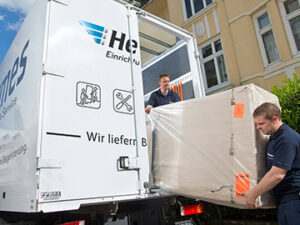
A practical example involving large household appliances illustrates this clearly. A heavy side-by-side refrigerator is delivered to an apartment building, the old appliance is removed from the kitchen, dismantled, and sent for proper recycling. Every additional task increases the time spent at the delivery location while simultaneously affecting vehicle loading, weight distribution, and the overall route schedule.
As a result, delivery operations become a dynamic system whose parameters are recalibrated at every stop.
Dispatch Planning: Returns as an Independent Planning Variable
A traditional delivery route calculates volume and weight requirements for each stop. When old appliance collection is added, the equation changes fundamentally. Vehicle capacity must be reserved for return goods, stop sequences and time windows must be coordinated with loading and unloading processes, and the disposal chain, including recycling partners and compliance documentation under Germany’s Electrical and Electronic Equipment Act (ElektroG), must be arranged in advance.
A route that collects old appliances at several of its roughly 20 stops is not simply a delivery tour where returns are a side note. It represents a distinct logistics model with its own planning requirements. This is particularly evident in exchange deliveries, where new and old appliances are transported on the same vehicle. Such operations require dispatch systems that actively calculate return capacities as part of the planning process.
Reliability and Flexibility at the Same Time
84% of consumers want to choose their delivery day and time window, while 76% expect timely advance notification. This is understandable. Nobody wants to block half a workday or take vacation time just to receive a washing machine delivery.
For operations planners, this creates a balancing act. The narrower the delivery window, the less room there is for spontaneous route optimization. At the same time, combined service visits increase uncertainty regarding the actual duration of each stop:
- Is access to the property unobstructed, and can the delivery vehicle park nearby?
- Does the new appliance fit easily through stairwells and hallways?
- Are there issues during installation or setup?
- Can the old appliance be removed immediately?
Complicating matters further, collecting an old appliance takes more time than a standard delivery. If this additional buffer is not included in calculations, the entire route can be delayed, delivery promises may not be met, and first-attempt delivery success rates will decline.
Well-structured systems achieve both objectives: sufficient reliability for customers and enough operational flexibility for adjustments throughout the day. Yet even the most advanced planning system is only as effective as the team handling the final mile on site.
Success Depends on Two-Person Handling Teams
The logistics industry often focuses on vehicles, software, and networks. Far less attention is paid to the people who ultimately deliver the service, even though for combined tours the qualifications of the two-person handling team often determine whether an assignment succeeds or fails.
Employees must install products, assess old appliances, document damage, handle packaging materials, and act as friendly, knowledgeable customer contacts. They constantly move between logistics, technical service, and customer support. In the large appliance sector, additional requirements come into play, including professional installation and removal, checks for refrigerant integrity, and compliance with labeling obligations under the ElektroG regulations.
As a result, the true quality moment of a purchase often occurs during the final minutes at the point of use, when the new appliance is put into operation and the old one is removed. From the customer’s perspective, manufacturer, retailer, and logistics provider frequently merge into a single experience. Brand perception is shaped where performance becomes immediately visible: in the customer’s home.
KPI Effects Should Not Be Calculated in Isolation
Delivery processes are still often measured primarily through cost per stop or vehicle utilization rates. For combined tours that bundle multiple services, this perspective is too narrow. The economic impact does not arise from individual KPIs but from their interaction.
A route that combines delivery, old appliance removal, and packaging disposal may require more time per stop, but it eliminates additional trips, accelerates return logistics processes, and simultaneously improves customer satisfaction and first-attempt delivery rates.
Relevant KPIs for combined and exchange delivery tours include:
- Average stop duration for combined-service stops
- Return collection rate per route
- Compliance rate for documented and proper disposal
- CO₂ savings achieved by reducing additional trips
At HES, KPIs are communicated transparently. Retail partners receive the monthly HES Quality and Performance Report (HES-QLR), featuring individually configurable metrics on volumes, lead times, and delivery reliability. This provides a foundation for targeted optimization instead of broad assumptions.
Conclusion: Making Complexity Manageable
The promise “new in, old out” is easy to make. Delivering on that promise without compromising efficiency, delivery reliability, or quality standards is the real challenge. Achieving this requires teams that can seamlessly switch between logistics and service tasks, as well as dispatch operations that factor return capacities into planning from the very beginning.
The last mile is increasingly becoming the starting point for new value creation. Delivery, installation, old appliance collection, packaging disposal, and customer communication come together in a single interaction. HES sees itself as a service partner that makes this complexity manageable through qualified two-person handling teams, structured processes, and transparency, transforming logistical challenges into customer value.