Old Appliance Removal When Purchasing a New Appliance: How Sustainable Take-Back Works
Replacing old household appliances with new, energy-efficient models is well underway, driven by government programmes, growing environmental awareness and technological advances in large electrical appliances. However, every refrigerator, washing machine and dishwasher delivered also creates a logistics-related challenge: the old appliance. Professional old appliance removal when purchasing a new appliance is therefore a key element of a sustainable, future-oriented supply chain. More and more retailers and manufacturers are relying on well-designed take-back solutions that combine ecological responsibility with operational efficiency. In this blog article, we explain how these solutions work.
Old appliances contain valuable resources, from stainless steel and copper to high-quality plastics, but they can also contain potentially harmful components such as refrigerants or electronic parts. This makes legally compliant and responsible disposal all the more important, as required, for example, by the German Electrical and Electronic Equipment Act (ElektroG).
The key challenge is that these appliances need to be collected efficiently and safely directly from the end customer, ideally at the same time as the new appliance is delivered to avoid additional journeys and CO₂ emissions. In practice, however, this take-back process often encounters difficulties at the interface between sales and logistics. If old appliance removal is not systematically integrated into the supply chain, gaps in documentation, incompatible schedules or unnecessary additional journeys can occur.
At the same time, there is a risk that old appliances are temporarily stored in basements or disposed of improperly, with negative consequences for the environment and recycling rates. A well-designed take-back process therefore begins not with collection, but when the order is placed. Only when all relevant information, such as size, weight, condition and removal requirements, is available at an early stage can disposal be organised effectively as part of a closed material cycle.
A sustainable take-back process begins at the checkout in an online shop or at the point of sale in a physical store. By actively and transparently offering old appliance removal when purchasing a new appliance, retailers create convenience while demonstrating responsibility and reliability. In day-to-day operations, this means:
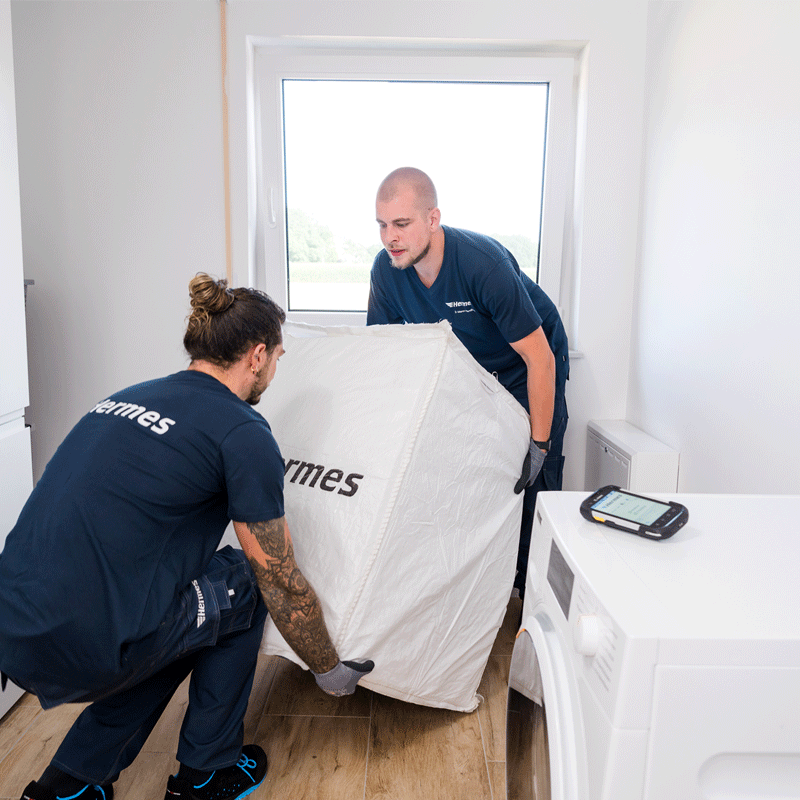
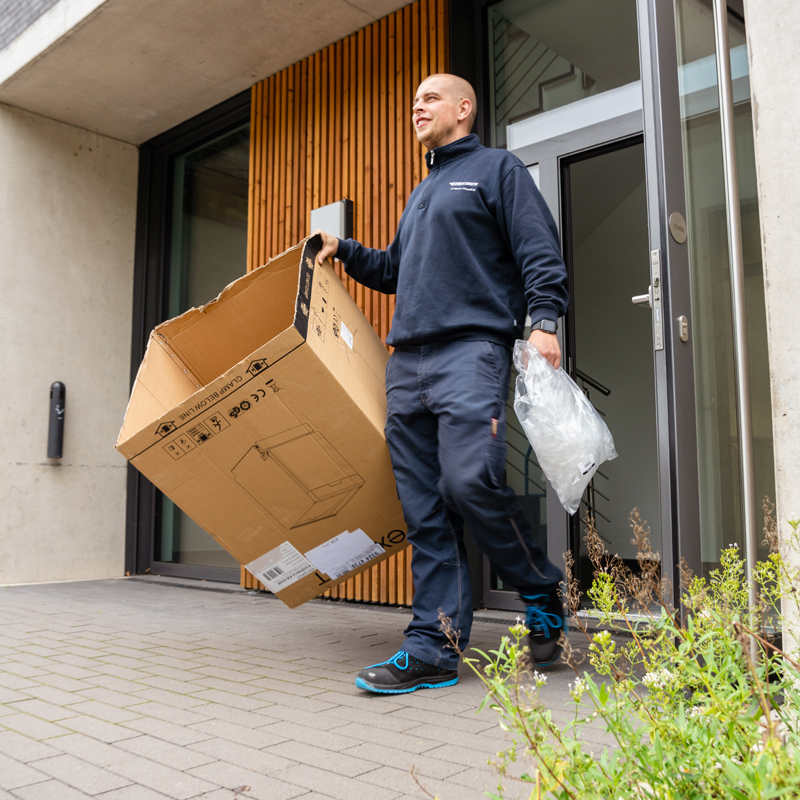
- The 2-man handling team collects the old appliance directly from the customer when delivering the new appliance. This means no additional appointments and no uncoordinated follow-up processes. Separate journeys, often involving subcontractors or municipal waste disposal companies, generate additional CO₂ emissions, higher operating costs and greater coordination effort.
- The appliances are professionally disconnected, packed, loaded and secured for transportation to prevent environmental damage and damage to the appliance. Even built-in or difficult-to-access appliances can be removed smoothly by trained delivery specialists.
- Digital tracking can also record the type, quantity, condition and disposal route of old appliances. This supports not only legal documentation requirements, but also internal quality assurance and traceability throughout the entire supply chain.
This creates a take-back process that is both logistically well designed and environmentally responsible, while integrating seamlessly into existing distribution processes. It reduces CO₂ emissions through consolidated transportation and helps conserve resources by returning valuable, reusable materials to the recycling cycle instead of allowing them to go to waste.
For retailers and manufacturers, this means that systematically integrating old appliance removal into their processes not only helps meet legal requirements, but also creates measurable environmental added value.
2-Man Handling: A Key Role in the Last Mile
Particularly for large household appliances, old appliance removal is far from a minor logistical process. With 2-man handling, expertise and careful handling are required at several operational levels.
On-Site Identification and Inspection
The old appliance not only needs to be moved, but also correctly identified and clearly matched to the collection order, particularly in the case of refrigerators and washing machines that are built in or look similar to the new appliance. Incorrect collections, duplicate collections or old appliances being left behind can only be avoided through clear communication and reliable on-site checks.
Technical and Physical Expertise
The 2-man handling team must have both the physical expertise to transport heavy appliances safely up several floors or through narrow passageways and the necessary technical knowledge. Permanently installed appliances must be professionally disconnected without damaging connections, floors or wall coverings. This also includes the safe handling of water and electrical connections and, in the case of refrigeration appliances, refrigerant connections.
Particular challenges arise in older buildings without lifts, narrow or winding staircases, or homes with narrow door frames. In such cases, physical strength alone is not enough. Experience and proactive planning are what really matter, including having the right equipment on hand, such as carrying straps, gloves, protective floor plates or stair-climbing trolleys.
Seamless Coordination of Delivery and Take-Back
Precise timing between the delivery of a new product and the collection of an old appliance is essential. From the arrival time and access to the home to the condition of the old appliance, closely coordinated processes help avoid waiting times and unnecessary journeys. Dispatch, customer communication and real-time status updates need to work seamlessly together, a combination that can be put under particular pressure during peak seasons such as Black Friday or Christmas.
Old appliances may also contain hazardous residues, such as traces of oil or sharp components. Professionally trained teams not only help prevent transport damage, but also protect the customer’s home and ensure the safety of the delivery teams.
Conclusion: Sustainable Take-Back Requires Structure and Specialists
Old appliance removal when delivering a new product requires precisely coordinated processes and trained personnel. Manufacturers and retailers should therefore choose their 2-man handling logistics partner carefully.’
HES provides the necessary infrastructure to return old appliances safely, efficiently and in compliance with legal requirements to the recycling cycle. Ideally, this takes place directly as part of the delivery, is seamlessly integrated into customer communication and managed through a digital, scalable system. This turns sustainability from an ambition into a process that is put into practice through logistics.