When consumers order a refrigerator, a stove, or a new TV, they are buying more than just a product. The checkout marks the beginning of expectations and questions that extend far beyond the order itself: When will it be delivered? Can the delivery appointment still be changed? Will the old appliance be taken away? Will installation go smoothly? And what happens if something doesn’t fit? The period following a purchase has become a crucial part of the customer journey for manufacturers and retailers. The so-called post-purchase experience encompasses every touchpoint between the order and product usage and is increasingly becoming a competitive differentiator, particularly in large-item logistics.
The Critical Phase: After Checkout
According to the Harvard Business Review, acquiring a new customer costs between five and twenty-five times more than retaining an existing one, depending on the industry. This clearly illustrates the strategic importance of the post-purchase phase. Nevertheless, many companies continue to invest the majority of their budgets and resources in acquisition and conversions. What happens after checkout often remains largely unmanaged.
For a long time, the actual purchase was considered the most important moment in the customer journey. However, increasing transparency in e-commerce is reshaping consumer expectations. Prices can easily be compared, and products are often interchangeable. As a result, differentiation is increasingly created through the delivery and service experience.
Especially when it comes to bulky or consultation-intensive products, the last mile often determines customer satisfaction. A premium television loses value in the customer’s perception if the delivery window remains unclear or the device does not work properly when switched on. Likewise, a washing machine is hardly perceived as convenient if customers have to arrange installation or old-appliance disposal themselves.
The post-purchase experience plays a vital role in customer retention, brand perception, and repeat purchases.
The Last Mile as Part of the Customer Experience
Large and heavy products often need to be delivered all the way to their intended place of use, assembled, or connected. According to an HES study on the topic of “Delivery as a Success Factor,” half of surveyed consumers (50%) would abandon their purchase and switch retailers when buying large electrical appliances if delivery to the place of use was not offered.
At the same time, expectations regarding communication and transparency continue to rise. Customers expect:
Gleichzeitig steigen die Erwartungen an Kommunikation und Transparenz. Endkund*innen erwarten:
- A specific delivery appointment instead of a vague delivery window
- Transparent real-time shipment tracking
- Advance delivery notifications before arrival
- Professional assembly or installation services
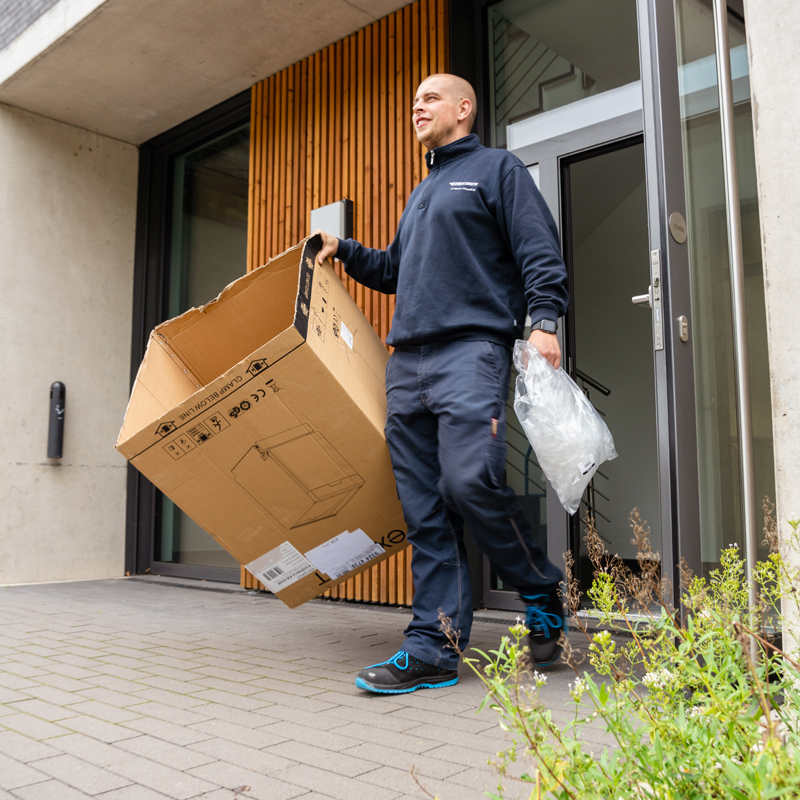
- Removal of packaging and old appliances
Particularly for high-value products, the delivery experience directly influences how professional a brand is perceived to be.
For example: A new dishwasher may arrive on time, but if it is delivered without installation support and left at the front door or curbside, frustration can quickly arise despite the product functioning perfectly. Conversely, if delivery is predictable, completed to the place of use, and includes installation and old-appliance removal, the entire purchase experience remains a positive memory.
Post-Purchase Experience – Transparency Builds Trust
Transparency and communication are among the most important elements of the post-purchase experience. Customer uncertainty often arises simply because information is missing.
An international study by zenloop and Parcel Perform, analyzing more than 65,000 parcel deliveries, showed as early as 2020 that 43.5% of consumers cited inaccurately communicated delivery times as the primary reason for a negative post-delivery experience, even ahead of undelivered parcels or poor customer service.
Although the study focused on parcel shipping, the importance of reliable communication is equally relevant for large-item logistics—particularly where customers need to plan their schedules and make preparations for delivery.
Dass dies auch heute noch Bestand hat, bestätigen die Ergebnisse des aktuellen HES Kompass 2026. Durch die Digitalisierung der letzten Meile können Unternehmen effizienter arbeiten und die Abstimmung mit den Endkund*innen verbessern. „Digitale Transparenz ist ein wirksames Instrument, um Zustellprozesse verlässlicher, planbarer und kundenfreundlicher zu gestalten“, sagt Fanny Haltenhof, Head of Customer Satisfaction Last Mile beim HES. „Wenn Kund*innen genau wissen, wann und wie ihre Lieferung ankommt, entfallen Rückfragen, Fehlzustellungen und teure Zusatzfahrten.“
This is particularly important in large-item logistics. Many customers need to adjust their daily routines around a delivery, remain at home—even while working remotely—or arrange assistance to ensure access to their residence. Modern tracking and delivery-notification solutions therefore play a crucial role in the overall service experience.
Assembly and Installation Drive Satisfaction
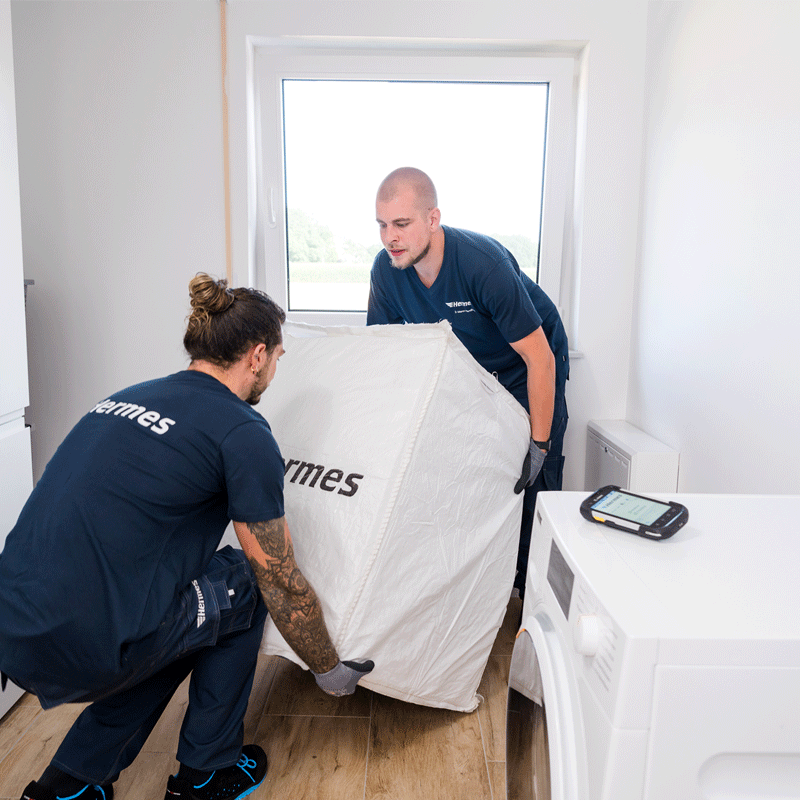
Wall-mounting large-screen televisions, connecting washing machines, commissioning refrigerators, or removing old appliances—these services go far beyond simply transporting an ordered product. However, not every customer requires every additional service. While some are satisfied with a reliable delivery, others expect a complete, worry-free experience. This creates a structural challenge for retailers and manufacturers: How can varying service expectations be met?
Flexible service models such as HES Smart and HES Premium enable companies to accommodate these differing requirements. From professional two-person handling to installation and commissioning on site, services can be tailored modularly to individual situations—either by the retailer or directly by the end customer.
Returns as Part of the Experience
Returns are also an integral part of the post-purchase experience, as they are far more complex for large products than for traditional parcel shipments.
Customers returning heavy appliances such as tumble dryers face very different challenges than those returning books or clothing. The results of the HES Compass demonstrate that retailers and manufacturers already recognize this as a competitive advantage: 68% of respondents consider a smooth returns process a decisive factor when choosing a logistics service provider.
A professional returns process is not defined by efficiency alone. Here too, transparency, clear points of contact, predictable pickup appointments, and seamless communication are critical.
Because operational processes and customer experience are closely intertwined in large-item logistics, returns should not be viewed merely as a cost issue but as a valuable tool for customer retention.
What Retailers and Manufacturers Can Actively Manage
The post-purchase experience is not a black box. It consists of processes that retailers and manufacturers can actively influence:
-
Define Service Levels
Which services are standard, and which are optional? Modular concepts such as HES Smart and HES Premium enable businesses to address different customer requirements effectively. -
Build a Seamless Communication Chain
From order confirmation and delivery notification to the final delivery itself, every customer touchpoint should be clearly defined and quality-assured. -
Leverage Data
Quality reports containing KPIs such as transit times, on-time delivery performance, and service execution provide retailers with valuable insights to identify weaknesses and continuously improve processes.
Every failed delivery, every instance of unclear communication, and every poorly managed return generates operational costs and can damage customer relationships. That is why Hermes Einrichtungs Service supports retailers and manufacturers with professional two-person handling and modular service solutions that combine operational efficiency with an outstanding customer experience.