Customers today expect more than an on‑time delivery: they want control over the appointment, transparency throughout the process, and the flexibility to tailor the service to their individual needs. For retailers and manufacturers shipping large electrical appliances and TVs, this means that a one‑size‑fits‑all product is no longer enough. Hermes Einrichtungs Service (HES) responds with two clearly defined delivery models — Smart and Premium — which can be expanded modularly and allow retailers to manage service depth and price point independently. This also introduces a market innovation for end customers.
Between Efficiency and Service: A Daily Balancing Act
Especially in the segments of large electrical appliances and consumer electronics, high product value, sensitive goods, and rising service expectations converge. Delivery has long become a central part of the overall shopping experience. A key challenge for retailers and manufacturers is that customer expectations can no longer be treated as uniform. While some customers primarily value fast and uncomplicated delivery, others want a comprehensive service experience that includes installation, setup, and removal of old appliances.
These differing requirements often lead to a conflict of goals in practice: standardized logistics solutions reach their limits because they either deliver too much or too little. Those who rely solely on a high service level risk unnecessarily high costs and shrinking margins. Those who offer only basic delivery fail to meet the expectations of many customers — especially when products require consultation or technical expertise.
The consequence: logistics today must deliver both — efficiency and flexibility.
Why Traditional Models Are No Longer Enough
Many logistics structures have evolved over time and are based on clearly defined service scopes. But as retail becomes increasingly individualized, the demands on the last mile are changing as well. Customers expect choices — not only regarding the product but also the delivery.
A “one-size-fits-all” approach often leads to inefficiencies:
- Services not needed are provided,
- Options for higher service needs are missing,
- and additional services are difficult to integrate.
As a result, logistics can quickly shift from a potential competitive advantage to a limiting factor.
Modular Delivery Models as a Response to New Requirements
- an efficient basic level for standardized requirements
- an extended service level for more demanding scenarios
A pricing structure with three product classes — M, L, and XL — ensures transparent and comparable calculations for retailers. The advantage lies in clarity: both retailers and end customers can quickly identify which service level fits the situation.
Smart and Premium: Two models, one clear logic
The strength of modular service options becomes particularly clear in everyday use. The choice of a specific service level often depends on the individual context in which it is needed.
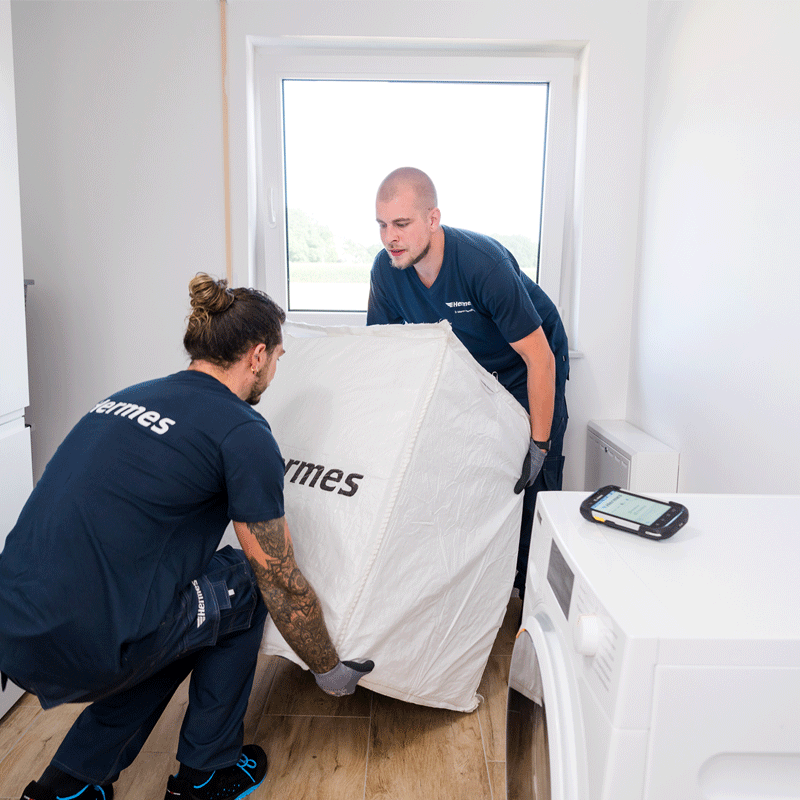
The Smart service provides professional two-man handling beyond the first lockable door – without pallets and without curbside delivery. This represents a clear upgrade from conventional general cargo solutions at an attractive price.
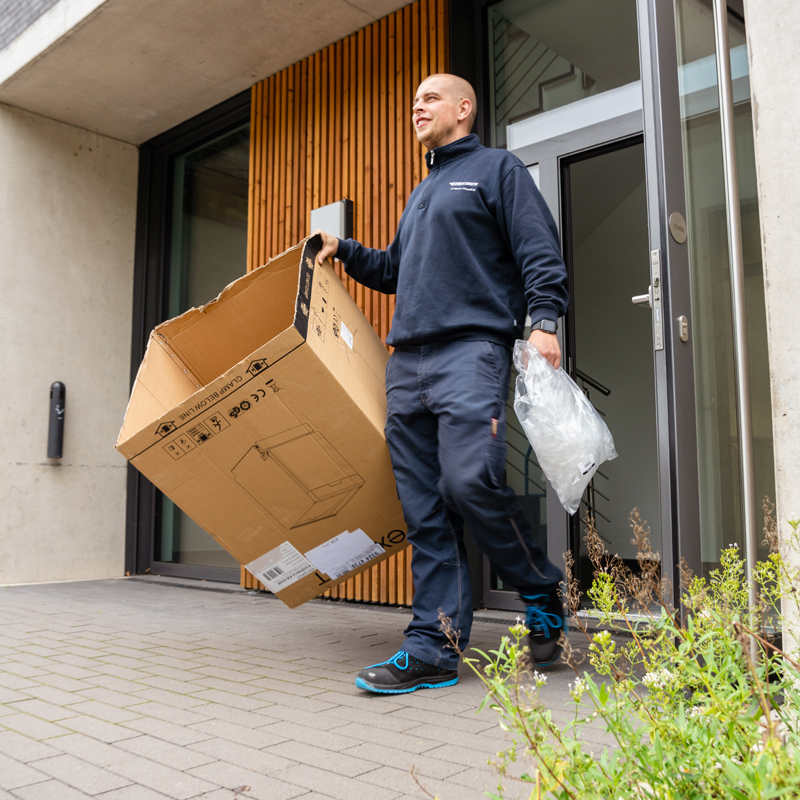
With the Premium service, goods are delivered directly to the desired place of use. Up to three delivery attempts are included, with short transit times. Retailers and manufacturers looking
Additional product-specific services can also be booked, such as:
A practical example: a customer who wants to install a TV themselves primarily needs a safe and reliable delivery. Another customer, however, may prefer a complete setup, including wall mounting and the connection of external devices.
The same applies to large household appliances: while some end customers simply expect reliable delivery, others value installation and commissioning.
Flexible models such as Smart and Premium are designed to reflect exactly this reality by addressing different requirements in a targeted way.
Market innovation: Flexibility even after the order has been placed
Another key aspect is the timing of flexibility. Not all requirements are fully known at the time the order is placed.
It is often only during the course of the process that end customers realise they need additional services, such as installation or the removal of an old appliance. Retailers and manufacturers can configure their offering modularly in advance and decide which additional services they want to make available to their customers.
In addition, end customers can use myhes.de to book extra services themselves or upgrade from Smart to Premium – after placing the order and up to a defined cut-off point before the delivery date. This option to add services independently at a later stage is currently unique in the market.
Less complexity behind the scenes, more choice for customers
Mehr Auswahl durch modulare Servicestrukturen muss dabei nicht automatisch zu mehr Komplexität führen. Zweistufige Modelle wie Smart und Premium reduzieren die Vielfalt an Einzeloptionen auf verständliche Basis- und Servicelevel und ermöglichen gleichzeitig eine gezielte Erweiterung durch Zusatzleistungen. Für Händler bedeutet das: einfachere Kalkulation, bessere Planbarkeit und klare Kommunikation gegenüber den Endkund*innen. Und für die Endkund*innen: mehr Transparenz, mehr Entscheidungsfreiheit und ein Lieferergebnis, das zur eigenen Situation passt.
Modular Delivery Models as a Response to New Requirements
Different customer expectations, increasingly complex products and growing competitive pressure make flexible delivery models essential. With Smart and Premium, HES demonstrates how efficiency and service can be combined effectively without making processes unnecessarily complex.
The option for end customers to book additional services themselves goes one step further: it shifts the service decision to where it can be made best – to the person receiving the product.