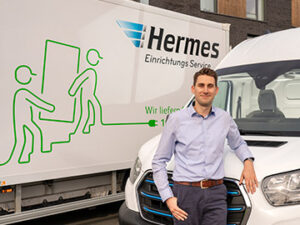
New Leadership shows itself in everyday work. In the Client Service department of Hermes Einrichtungs Service (HES), this means: clear structures instead of tight control, personal responsibility instead of top‑down instructions, and an open communication culture where problems are addressed directly. As Team Lead Client Service Group, Janis Busekrus describes how this approach works in day‑to‑day operations and why letting go is one of the most challenging yet effective leadership skills.
What does your leadership style look like, and how does it differ from traditional structures?
Janis Busekrus: My leadership style as Team Lead Client Service Group is based on the principles of New Leadership, with clarity, trust, and open communication being especially important to me. In contrast to traditional hierarchical structures, where instructions come exclusively from the top, we rely on clear structures within the team, supported by open communication and mutual trust.
Clarity means this: Despite the New Leadership approach, I place great value on clear instructions and responsibilities. In Client Service, it is essential that everyone knows exactly what needs to be done and what their area of responsibility is. We achieve this through transparent processes and regular coordination.
Trust, to me, means refraining from excessive control and instead fostering personal responsibility and confidence in decision‑making. I am convinced that motivated and self‑directed employees achieve the best results. And open communication is the prerequisite for making this work. Challenges or problems are addressed directly rather than swept under the rug. Only then can we find solutions together and continuously improve. This leadership mindset reflects what has been systematically anchored at HES since 2023: trust replaces control, and responsibility is consciously shifted to where the expertise lies.
How does this look in practice?
Janis Busekrus: Clear structures and responsibilities form the foundation for independent work. Since all team members know their areas well, excessive control is unnecessary. I encourage them to actively develop their areas and bring in new ideas. If someone identifies potential for improvement in an existing workflow, I support them in optimizing and implementing it. The difference from traditional leadership lies less in the goals and more in the path toward them: not prescribing, but enabling.
How do your team, the company, and your customers benefit from this leadership approach? What concrete results or changes have emerged?
Janis Busekrus: A concrete example is the introduction of our new ticket system. In the process, we not only optimized workflows but also automated many manual tasks. This frees up capacity within the team, which we can use for other important tasks.
What stands out most is the team’s strong willingness to embrace change and take on new tasks. The freed‑up capacity is seen as an opportunity to grow and acquire new skills. This directly benefits our customers: we can respond to their concerns more quickly and flexibly. Overall, our leadership approach leads to higher satisfaction — both among employees and customers.
What challenges come with this leadership approach, and how do you handle them?
Janis Busekrus: One of the biggest challenges is that, as a leader, you must be able to let go and delegate. This requires trust in the abilities of your employees and the acceptance that you cannot know everything. In fact, my team members are often subject‑matter experts in their respective areas, with deeper knowledge than I have. Acknowledging this is not a weakness — it is a prerequisite for good leadership. New Leadership does not mean having no stance; it means using your stance consciously for the benefit of the team.
How do you measure or recognize the success of your leadership style or model?
Janis Busekrus: Through two things equally: feedback from clients and feedback from employees. Client satisfaction shows whether we meet their expectations and deliver added value. Employee feedback shows whether they feel appreciated and supported, and whether they can carry out their tasks with motivation and autonomy. To ensure this, I regularly hold one‑on‑one conversations to listen to their concerns and continuously improve our work environment.
Looking ahead: How will leadership continue to evolve in your area?
Janis Busekrus: I see leadership as a continuous learning process and remain open to new approaches. What works today may not be the right thing tomorrow. I stay open to feedback from the team, to new impulses, to experimentation. Leadership that enables this not only creates better results — it creates a work environment where people can truly feel at home. And that is ultimately the goal of the New Leadership approach at HES.