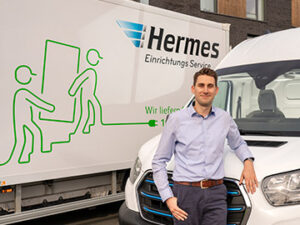
Hakan Sanal, Supervisor in Outbound and Facility Management, has been with HES since August 2013. In this interview, he explains how his leadership approach is reflected in daily operations and why a declining sick leave rate says more about leadership quality than any organizational chart.
What does your leadership style look like, and how does it differ from traditional structures?
Hakan Sanal: My leadership style is strongly based on trust. I encourage my team to make bold decisions and take responsibility. Unlike traditional structures, where everything has to go through me, I rely on my team members’ independence. I see my role more as providing them with the freedom and resources they need to act autonomously and develop innovative solutions.
This understanding aligns with what HES has been establishing under the term New Leadership since 2023: leadership should create enabling structures, not act as a control mechanism. When responsibility is truly delegated, it unlocks competencies that would otherwise remain unused. Especially in the operational environment of our logistics hub in Löhne, where fast decisions are required every day, this mindset becomes a competitive advantage.
How does this manifest in everyday work?
Hakan Sanal In our daily work, it leads to greater ownership and increased engagement among employees. A clear indicator of this is the reduced sick leave rate. It shows that we have more motivated colleagues who enjoy their work and identify with their tasks.
The sick leave rate is a very insightful indicator of leadership. You can see it in everyday life: those who experience themselves as effective and empowered show up. Those who feel like they are just a function are more likely to stay home. At the HUB Löhne, the development of the sick leave rate is therefore not coincidental—it reflects leadership culture and employee satisfaction.
If you had to describe your leadership model in three words, what would they be?
Hakan Sanal: Motivating. Inspiring. Empowering.
How do the team and the company benefit from this leadership approach?
Hakan Sanal: Both the team and the company benefit equally. By giving trust and promoting personal responsibility, we don’t just achieve our goals—we actually exceed them. Specifically, it has become clear that the working climate has improved significantly and stress levels for individual team members have decreased. This leads to higher motivation and creativity within the team, which in turn positively impacts results.
What challenges come with this leadership approach?
Hakan Sanal: I offer support and coaching to help my employees develop their skills and overcome challenges. I promote a culture where mistakes are seen as learning opportunities and where people feel safe to take risks. Both ideas sound simple, but in practice, they are demanding.
A true error culture must be consistently demonstrated. For example, when a decision goes wrong within the team, the subsequent discussion must not end in blame—it must lead to shared understanding. Coaching, on the other hand, requires time, which is often limited in daily operations.
HES addresses these challenges structurally, for example through its leadership learning network, where supervisors and leaders from different areas learn from each other and reflect on real-life cases.
What role does ownership play in your team?
Hakan Sanal: It is our foundation. I see it as my most important task to enable every team member to take responsibility for their tasks and decisions. Everyone has the opportunity to actively shape and improve processes and workflows.
I support this by regularly gathering feedback and encouraging open discussions. Participation is not a decorative element—it is operationally impactful. My employees work within these processes every day and recognize optimization potential faster than any external perspective. Influence and initiative arise where expertise resides, regardless of position or hierarchy level.
How do you measure the success of your leadership style?
Hakan Sanal: Primarily through the KPIs we achieve. If we don’t reach our KPIs, we work together as a team to analyze root causes and find ways to improve the situation. For us, metrics become a steering tool—a core principle of New Leadership at HES.
How is leadership evolving in your area?
Hakan Sanal: In our area, leadership will continue to evolve toward greater agility and ownership. New Leadership is an ongoing development process, not a finished program.
For the HUB Löhne, this means even more decentralized decision-making, faster responses to operational changes, and a team that continues to act proactively instead of waiting for instructions.
Series on New Leadership at HES
This article is part of our series on leadership styles at HES. Read our other profiles and articles on New Leadership: